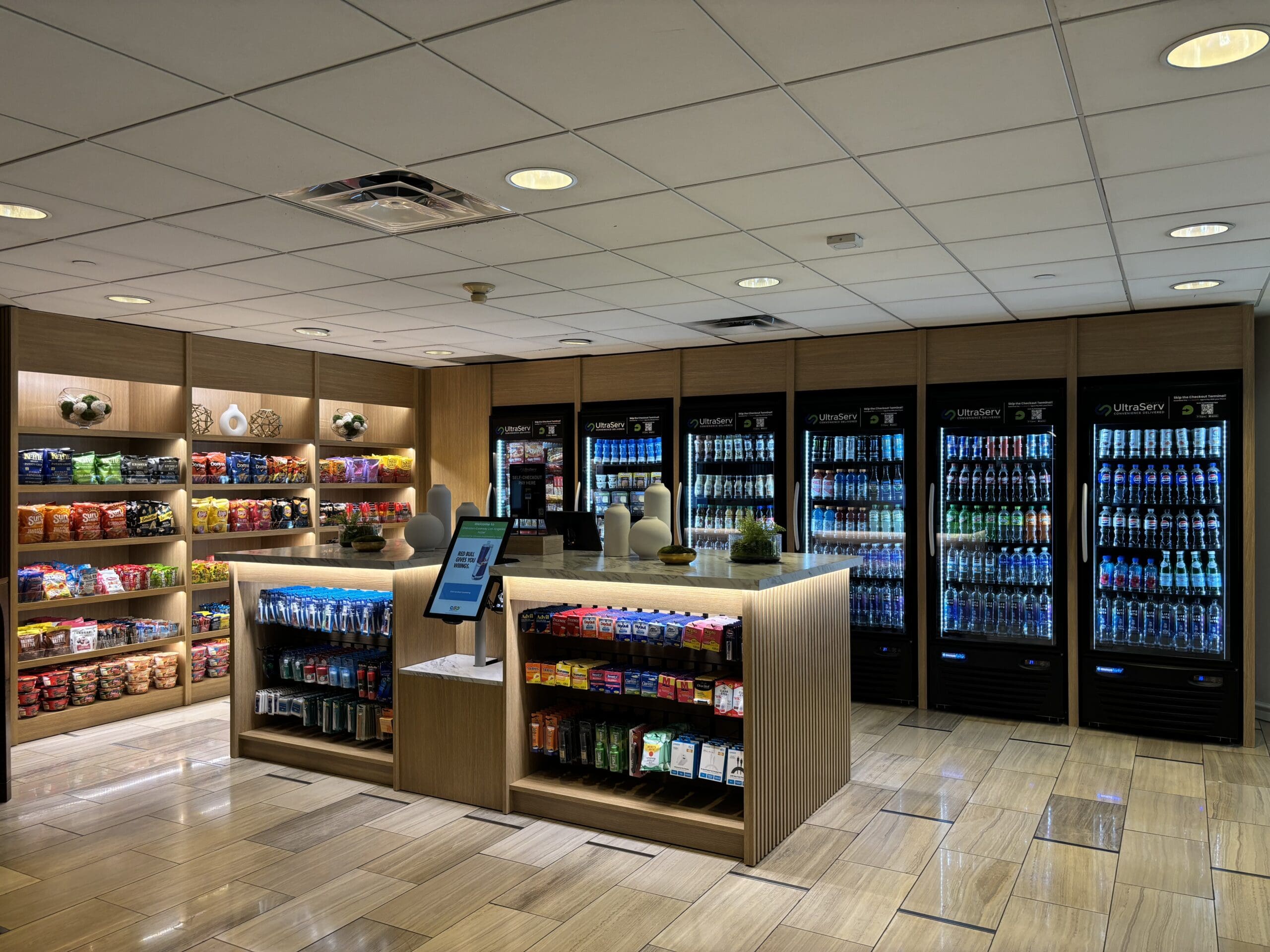
Let’s face it: most hotel lobby markets don’t drive the revenue they could. Shelves are understocked, displays look neglected, and guests often walk past without even glancing.
At GrabScanGo, we’ve learned that the difference between a struggling market and a successful one isn’t just the products – it’s the presentation. That’s why we introduced Beauty Stock™: a mathematically-defined merchandising standard that ensures your market always looks full, fresh, and guest-ready.
What Is Beauty Stock?
Beauty Stock is the minimum level of front-facing inventory needed to maintain a clean, inviting, and well-stocked appearance – even when product levels are running low.
The Mathematical Definition
Traditional inventory management relies on these core formulas:
Safety Stock (SS):
SS = z × σ × √L
Where:
- z = Service level factor (e.g., 1.65 for 95% service level)
- σ = Standard deviation of demand
- L = Lead time
Reorder Point (ROP):
ROP = (μ × L) + SS
Where μ = Mean demand per period
Minimum Stock Level:
Min Stock = ROP
Maximum Stock Level:
Max Stock = ROP + EOQ
Where EOQ = Economic Order Quantity
Beauty Stock Enhancement
Beauty Stock builds upon traditional inventory management by introducing dynamic visual thresholds based on product performance:
For High-Velocity Products:
Beauty Stock_high = max(0.20 × C, SS)
For Low-Velocity Products:
Beauty Stock_low = max(1 unit, SS)
Where:
- C = Maximum visual display capacity
- SS = Traditional safety stock calculation
- 0.20 = Visual presence threshold for fast-moving items
- 1 unit = Minimum presence threshold for slow-moving items
Enhanced Reorder Point with Beauty Stock:
ROP_beauty = max(ROP_traditional, Beauty Stock)
This ensures that reorder triggers account for both operational needs AND differentiated visual presentation requirements.
The Beauty Stock Coefficient (BSC)
We measure visual performance using product-specific Beauty Stock Coefficients:
For High-Velocity Products: BSC_high = Current Stock Level ÷ Maximum Display Capacity
- BSC ≥ 0.20: Beauty Stock maintained
- BSC < 0.20: Below threshold (appears understocked)
For Low-Velocity Products: BSC_low = Current Stock Level (minimum 1 unit)
- Stock ≥ 1: Beauty Stock maintained (product available)
- Stock = 0: Below threshold (product unavailable)
In our well-managed lobby markets, we maintain BSC_high ≥ 0.20 for high-velocity products and ensure continuous availability (≥1 unit) for specialty items.
At GrabScanGo, we developed the 20% Beauty Stock threshold in collaboration with one of our top-performing service operators — someone who manages hundreds of hotel lobby markets across diverse property types. This threshold isn’t theoretical; it reflects what actually works to keep displays looking full and attractive between restocks. We also base the visual capacity (C) on known cooler and rack specs: number of facings multiplied by the number of slots per facing. That makes the Beauty Stock model both easy to implement and adaptable to any market configuration.
The Data Speaks for Itself
The mathematics of differentiated visual merchandising are compelling:
- Over 70% of purchase decisions are made at the point of sale
- Well-merchandised displays can increase sales by up to 30%
- U.S. retailers lose more than $125 billion per year to poor visual merchandising
Our Real-World Results
Case Study: Hotel Lobby Market Transformation
When we switched service operators for one hotel lobby market – implementing differentiated Beauty Stock maintenance – we observed:
- Sales increase: +34%
- High-velocity product BSC improvement: 0.12 → 0.25
- Low-velocity product availability: 67% → 94%
- Guest engagement rate: +41%
The product selection didn’t change. The location didn’t change. Only the mathematical precision of our differentiated merchandising execution improved.
The Beauty Stock Performance Model
Our comprehensive inventory analysis reveals the relationship between traditional metrics and differentiated visual performance:
Traditional Model:
- Focuses solely on P(Stockout) = 0
- Minimizes total cost = Ordering cost + Holding cost + Stockout cost
Beauty Stock Model:
- Includes Differentiated Visual Appeal Cost (DVAC) in total cost equation
- Total Cost = Ordering + Holding + Stockout + Differentiated Visual Appeal Cost
- Where DVAC increases when BSC_high < 0.20 or low-velocity products = 0
Performance Correlation: Our data shows strong correlation between differentiated BSC and sales performance:
High-Velocity Products:
- BSC < 0.15: Revenue performance at 70% of potential
- BSC 0.15-0.19: Revenue performance at 88% of potential
- BSC ≥ 0.20: Revenue performance at 100%+ of potential
Low-Velocity Products:
- Stock = 0: Lost sales opportunity (100% revenue loss for that product)
- Stock ≥ 1: Full revenue potential maintained
Mathematical Validation: Across 200+ hotel lobby markets, we observe:
For High-Velocity Products:
Revenue Performance = 0.35 + 3.25(BSC_high) - 1.2(BSC_high)²
R² = 0.823
For Low-Velocity Products:
Revenue Performance = Stock_availability × Product_margin
Where Stock_availability = 1 if stock ≥ 1, else 0
GrabScanGo = Mathematically Managed, Always Guest-Ready
We turn underused spaces – like old business centers or gift shops – into algorithmically managed, high-performing lobby markets.
Our Beauty Stock Protocol
Every GrabScanGo market maintains mathematically-calculated inventory levels:
Traditional Inventory Calculations:
For each product category, we calculate:
- Demand Analysis & Classification:
- μ = Mean daily demand
- σ = Standard deviation of demand
- Lead time (L) analysis
- Velocity Classification: High (>1 unit/day) vs Low (<1 unit/day)
- Safety Stock Calculation:
SS = 1.65 × σ × √L (for 95% service level) - Traditional Reorder Point:
ROP = (μ × L) + SS - Economic Order Quantity:
EOQ = √(2DS/H)Where D = annual demand, S = order cost, H = holding cost
Beauty Stock Integration:
- Differentiated Beauty Stock Calculation:
Beauty Stock_high = max(0.20 × C, SS) [High-velocity] Beauty Stock_low = max(1 unit, SS) [Low-velocity] - Enhanced Reorder Point:
ROP_beauty = max(ROP_traditional, Beauty Stock) - Visual Performance Monitoring:
BSC_high = Current Stock ÷ Display Capacity  [Target: ≥0.20]
Stock_low = Current Units                     [Target: ≥1]
This differentiated approach optimizes both inventory efficiency AND visual appeal based on product performance.
GrabScanGo handles every aspect of the operation:
- Inventory sourcing & setup with differentiated Beauty Stock calculations
- Routine stocking & merchandising to maintain BSC thresholds
- ADA-compliant self-checkout kiosk
- Sales tracking & guest insights with performance-based BSC metrics
- Mathematically-driven, differentiated Beauty Stock maintenance on every visit
Performance Guarantees
With our differentiated Beauty Stock system, you can expect:
- BSC ≥ 0.20 maintained 95%+ of operating hours for high-velocity products
- ≥1 unit availability maintained 92%+ of operating hours for low-velocity products
- Combined visual service level of 96% (market always appears well-stocked with appropriate product mix)
- Higher guest satisfaction and engagement across all product categories
- Measurable increases in both impulse purchases and specialty item sales
- Reliable, recurring revenue with mathematical predictability
The Beauty Stock Advantage
When high-velocity products operate below BSC 0.20, guests perceive scarcity in popular items. When specialty products show zero availability, guests assume limited selection. Our differentiated Beauty Stock approach ensures that:
- Popular items maintain visual abundance (20% minimum presence)
- Specialty items maintain continuous availability (always at least 1 unit)
- The market appears both well-stocked AND diverse
Beauty Stock isn’t just merchandising – it’s applied mathematics with performance-based optimization that delivers measurable results.
And with GrabScanGo, precision comes built-in.
Beauty Stock™ is a trademark of GrabScanGo. Our differentiated mathematical framework represents years of data analysis across hundreds of hotel lobby markets, quantifying optimal visual thresholds based on product velocity and guest behavior patterns.