Shopper behavior in convenience markets and self-checkout
In U.S. convenience stores, the average basket size is about $7.80 per visit. That typically translates to two to four items per trip.
Our markets — located in hotels, offices, apartments, and other properties — follow almost the exact same pattern. At GrabScanGo markets, the average shopper buys two items per visit.
And with our self-checkout solution, those two items are scanned and paid for in under 15 seconds. For many shoppers, the process is closer to ten seconds — from opening our App Clip on their phone, to scanning barcodes, to completing payment.
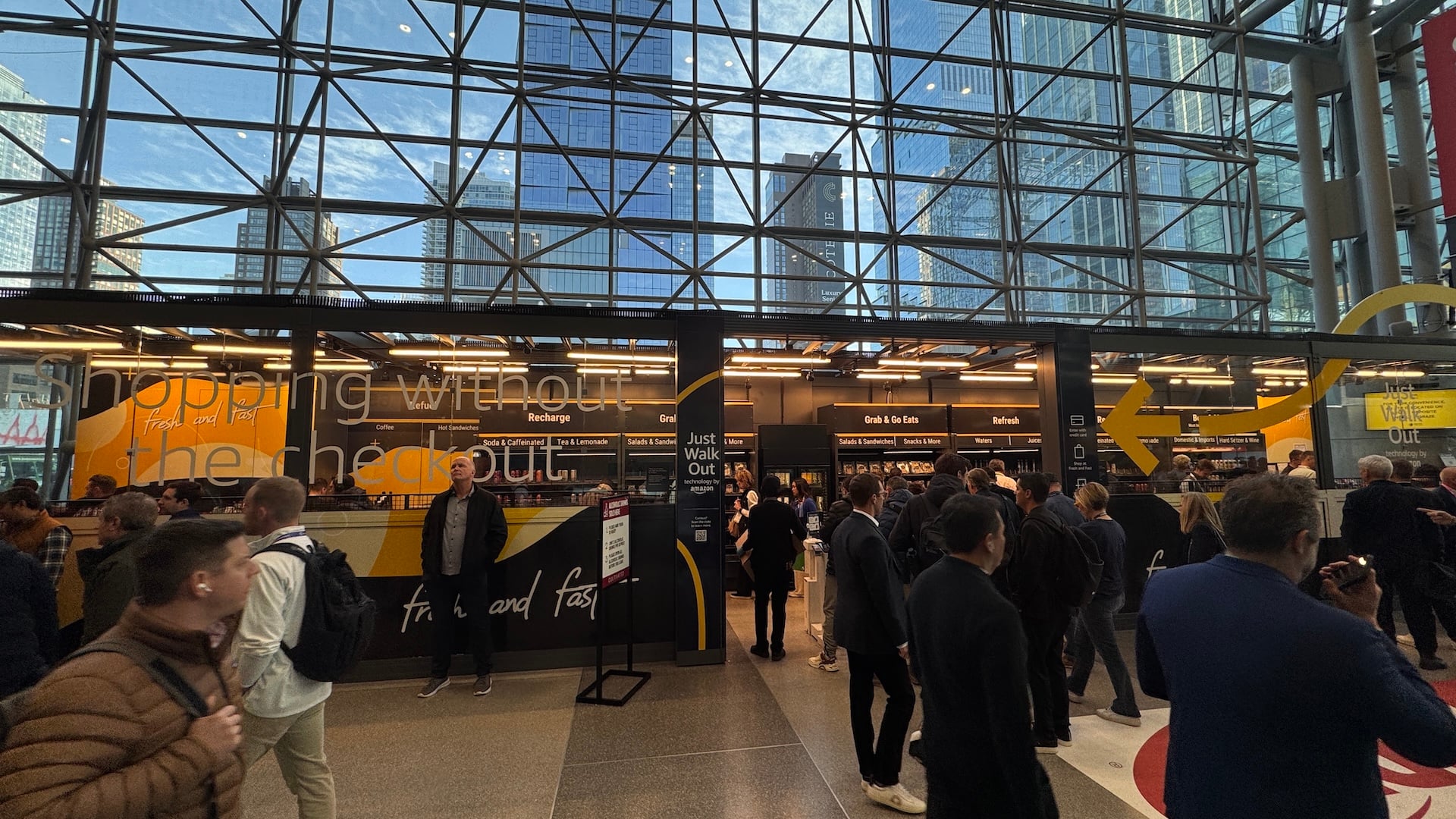
When the real-world basket size is two items and checkout takes seconds, does it make sense to deploy costly, complex AI self-checkout systems?
What operators see with unattended retail
Operators servicing industrial and office locations often tell us the same story: employees take breaks at the same time, so multiple people are at the market all at once.
With traditional kiosk-only setups, that means lines — unless you invest in multiple terminals. With our approach, every shopper’s phone becomes its own self-checkout terminal. We’ve seen employees complete purchases in as little as four seconds.
During peak break times, we’ve regularly observed ~10 simultaneous transactions through smartphones — equivalent to deploying 10 AI/CV kiosks at hundreds of thousands in hardware costs, but accomplished with zero additional equipment investment.
It’s proof that scalability doesn’t always come from adding complexity. Sometimes it comes from removing it.
The unsung hero: the humble UPC barcode
Sometimes innovation isn’t about replacing what works — it’s about using it better. The UPC barcode may not make headlines, but it has quietly powered billions of transactions every day for decades.
In our convenience markets, that humble UPC is the hero. Shoppers simply scan a barcode — either with the scanner on our ~$3,000 self-checkout terminal or with the camera on their own phone. In both cases, checkout is fast, reliable, and intuitive.
No guesswork. No misreads. No massive hardware investment.
The hidden challenges of computer vision checkout in unattended retail
Perfecting computer vision self-checkout isn’t simple. Lighting, packaging changes, and shopper behavior can all throw off accuracy. That’s why companies pursuing CV solutions pour significant time and R&D into making them viable in unattended retail environments.
Beyond accuracy challenges, AI/CV systems face ongoing reliability issues. They require regular software updates, can fail when cameras accumulate dust or condensation, and often need specialized technical support when problems arise. UPC scanners, by contrast, are essentially maintenance-free and have decades-proven uptime records.
Even when CV systems work perfectly, they often require high-end cameras, powerful edge computing hardware, and constant connectivity. That’s a lot of cost and complexity — especially when the average basket is just a few items.
Meanwhile, the UPC barcode — a standard that’s already everywhere — solves the same problem instantly, accurately, and at a fraction of the cost.
Total cost of ownership: The numbers tell the story
For operators, it’s not just about hardware — it’s about total cost of ownership (TCO).
While our barcode-based solution typically costs under $10,000-$15,000 over three years per location, comparable AI/CV systems can run $40,000-60,000+ per location over the same period. AI and CV-based kiosks often come with high fixed monthly costs of $800-1,500+, regardless of how much the market actually sells. Whether sales are strong or slow, that bill stays the same.
By contrast, simpler barcode-based checkout models are designed to reduce risk and scale more efficiently. They avoid oversized fixed costs, making it easier for operators to open more convenience markets with less financial strain — and to do it with confidence that the economics will work in both high-traffic and modest-traffic locations.
Proven simplicity vs. costly complexity
To identify a soda and a bag of chips, operators don’t need an array of cameras and advanced AI. The humble barcode — paired with a scanner or a phone camera — already solves the problem.
And it solves it better. CV systems can be thrown off by glare, unusual packaging, or a shopper picking up multiple items at once. By contrast, a barcode scan is accurate, instantaneous, and universally understood. It just works.
To be clear, AI and computer vision technologies have their place. In large format retail environments with complex product mixes, high-value transactions, or specialized use cases, the additional sophistication may justify the investment. But in convenience markets where simplicity and reliability matter most, the technology often becomes a solution in search of a problem.
The bigger picture for unattended retail
When you step back and look at the fundamentals:
- The average basket is two to four items
- Checkout takes under 15 seconds
- Shoppers can scan with either a low-cost terminal or their own phone
- Operating costs remain predictable and scalable
…then adding layers of AI and computer vision isn’t innovation. It’s over-engineering.
The question for convenience market operators isn’t whether AI checkout technology is impressive — it certainly is. The question is whether it’s the right tool for your specific business needs and customer behavior patterns.
Sometimes the smartest solution is the simplest one. And sometimes the true hero is the tool that’s been quietly solving the problem all along: the humble UPC.
The bottom line for operators: Evaluate solutions based on your actual needs, not technology headlines. In convenience markets where speed, simplicity, and cost-effectiveness matter most, the 50-year-old barcode standard often outperforms today’s most sophisticated AI systems.